Product Overview
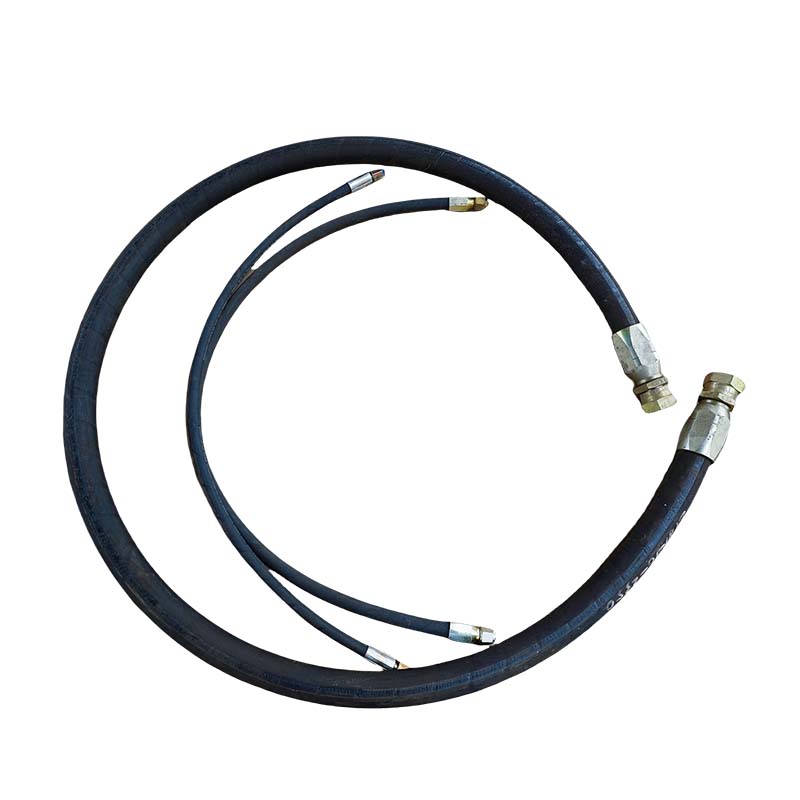
A high-pressure oil hose assembly is a flexible piping system used to transport high-pressure liquids (such as hydraulic oil and fuel oil). It typically consists of a high-pressure hose (reinforced with braided or spiral steel wire), a metal fitting (joint), and a pipe clamp. It can withstand extremely high pressure and is commonly used in engineering machinery, the petroleum industry, and shipbuilding. Its key features are high pressure resistance, wear resistance, high temperature resistance, and sealing performance.
Key Features
High-pressure hose body:
Typically a specially made rubber hose with an oil-resistant inner layer, a middle layer reinforced with high-strength steel wire (one, two, or four layers, etc.) braided or wound, and an outer layer that is wear-resistant and aging-resistant.
High-pressure connector/pipe end:
A metal component; one end connects to equipment (such as an injector or common rail), and the other end is firmly connected to the hose through cold pressing (heading) to ensure a seal.
Seals:
Ensure no leakage at the connection.
Application Scope
Tamping Equipment:
Hydraulic actions such as the insertion, clamping, and lifting of the tamping pick by a tamping machine require high-pressure oil pipes to supply power to the hydraulic cylinders and motors.
Screening Equipment:
The hydraulic system of the excavating chain drive, vibrating screen, and conveyor belt mechanisms of a screening machine.
Stabilizing Equipment:
The vibration excitation device and clamping device of a stabilizing vehicle; the oil pipes must withstand high-frequency vibration and pulse pressure.
Battery Shaping Equipment:
The hydraulic actions of the ballast shaping vehicle, such as plow plate lifting, side plow deployment, and conveyor belt operation.
Grinding Cart:
Hydraulic drive for the feed, lifting, and rotation motors of the grinding head.
Milling Cart:
Driven by a powerful milling motor.
Flash Welding/Aluminothermic Welding Equipment:
Hydraulic functions such as clamping, alignment, and edge removal.
FAQ
Q: How can I determine if the high-pressure hose assembly is compatible with my equipment? What parameters are required?
A: To ensure accurate matching, please provide the following key information:
Interface Specifications: Thread type (metric, imperial, US), dimensions, sealing type (e.g., flat seal, conical seal, O-ring seal), and brand standard (e.g., Parker, Eaton, Yonghua, etc.) of both ends of the connector.
Operating Parameters: Maximum working pressure (normal and peak), operating temperature range, and media type (e.g., hydraulic oil, fuel oil, lubricating oil, etc.).
Size Requirements: Hose diameter (inner diameter), overall length (center distance between both ends of the connector or specific installation dimensions).
Q: What materials and processes are used in the product? How is durability guaranteed?
A:Inner Rubber Layer: Made of oil-resistant, heat-resistant, and wear-resistant synthetic rubber (e.g., NBR, FKM, etc.) to ensure media compatibility.
Reinforcing Layer: Employs a high-strength multi-layer steel wire braided or wound structure, providing excellent pressure resistance and pulse resistance.
Outer rubber layer: Made of anti-aging, wear-resistant, and environmentally resistant rubber or polyurethane to adapt to various working conditions.
Connector: Made of high-quality carbon steel or stainless steel, precision CNC machined and surface treated (e.g., galvanizing, nickel plating, Dacromet) to ensure rust prevention and connection strength.
Crimping process: Utilizes a high-precision CNC crimping machine to achieve dual control of pressure and displacement, ensuring permanent sealing and pull-out resistance at each crimping point. We provide process control records for review.


